The Constitutional Court in Blantyre will from December 2 start reviewing the laws that make homosexuality an offence that attracts a maximum 14-year-jail term.
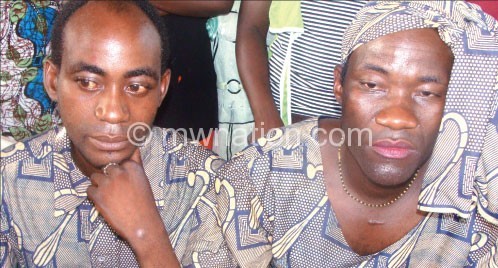
Malawi received both local and international condemnation during the regime of the former president the late Bingu wa Mutharika when a magistrate court on May 20 2010 sentenced two men to the maximum 14 years imprisonment each for engaging in homosexual activities.
The nation, under President Joyce Banda, continues to face pressure from some local and international lobby groups and donors to scrape off the laws that criminalise homosexuality, described by the campaigners as archaic.
This time around the court is expected to come up with a decision on whether the laws that make homosexuality an offence or not are constitutional as the court makes confirmation on 2011 cases involving three men currently serving prison sentences following their convictions for engaging in homosexual activities.
The three men are Amon Champyuni, Mathew Bello and Mussa Chiwisi, all convicted by magistrate courts in Blantyre.
Champyuni, convicted on July 27 2011, was slapped with the maximum 14-year jail term; Bello earned a 12-year jail term on September 7 2010 while Chiwisi was slapped with a 6-year prison term on September 29 2010.
They were all separately accused of having carnal knowledge of fellow men.
The court, which is set to consider convictions of the three based on constitutionality of Section 153(a) of the Penal Code vis-à-vis Section 20(1) of the Constitution, has invited interested parties such as the Malawi Law Society (MLS), the Malawi Human Rights Commission (MHRC), local and international civil society groups, religious groups and individuals to join the case as friends of court.
Centre for the Development of People (Cedep) executive director Gift Trapence said this is Malawi’s opportunity to deal with the matter that has for a long time put the country on the spot—including the visit by the United Nations (UN) secretary general Ban Ki-moon following the conviction of the two men, Tiwonge Chimbalanga and Steven Monjeza, to 14 years imprisonment with hard labour each for holding an open engagement ceremony in Blantyre. Mutharika, mainly under pressure from the international community, was forced to pardon he two.
The MLS has also said it will join the case to represent the interests of Malawians and help the court arrive at a better decision.
MLS secretary Felisah Kilembe said in an interview she could not say much on the matter as they were still preparing for the case.
In contention on December 2 is the country’s Penal Code, Section 153, which stipulates that any person who (a) has carnal knowledge of any person against the order of the nature; or (b) has carnal knowledge of an animal; or (c) permits a male person to have carnal knowledge of him or her against the order of nature, shall be guilty of a felony and shall be liable to imprisonment for 14 years, with or without corporal punishment.
In November 2012, President Banda said Malawi was not ready to repeal laws which criminalise homosexuality despite her pledge after taking office to review the legislation.
Amid donors’ caution to Malawi to respect human rights, including sexual minorities, and at a time government was arresting and convicting people for engaging in homosexuality activities, Banda’s administration through Ministry of Justice and Constitutional Affairs suspended laws that criminalises homosexuality early November in 2012.
But the suspension of the laws that criminalises homosexuality was challenged by the MLS, who argued it was not only unconstitutional but also an infringement of the principle of separation of powers between the Executive and the Legislature.
In Africa, countries where homosexuality is legal or was decriminalised include South Africa, Mali, Rwanda, Burundi, Gabon, Cote d’Ivoire, Cape Verde and Central Africa Republic.